
At Alison’s Montessori, we are always excited to provide children with hands-on , engaging materials to grasp abstract concepts such as binary numbers. Our beautifully designed material introduces the foundational concepts of binary numbers, the base-2 numeral system that uses only 0s and 1s. This material is ideal for learners in the upper elementary years (ages 10-12) who are ready to study more advanced mathematical concepts and their real-world applications. The set includes three main components: a wooden board with slots labeled with powers of 2, a laminated control chart that serves as a reference guide, and a set of 56 task cards. In this blog post, we will provide a short description for each section of the Binary Number System Task Cards and how they work with the Binary Number System.
Materials
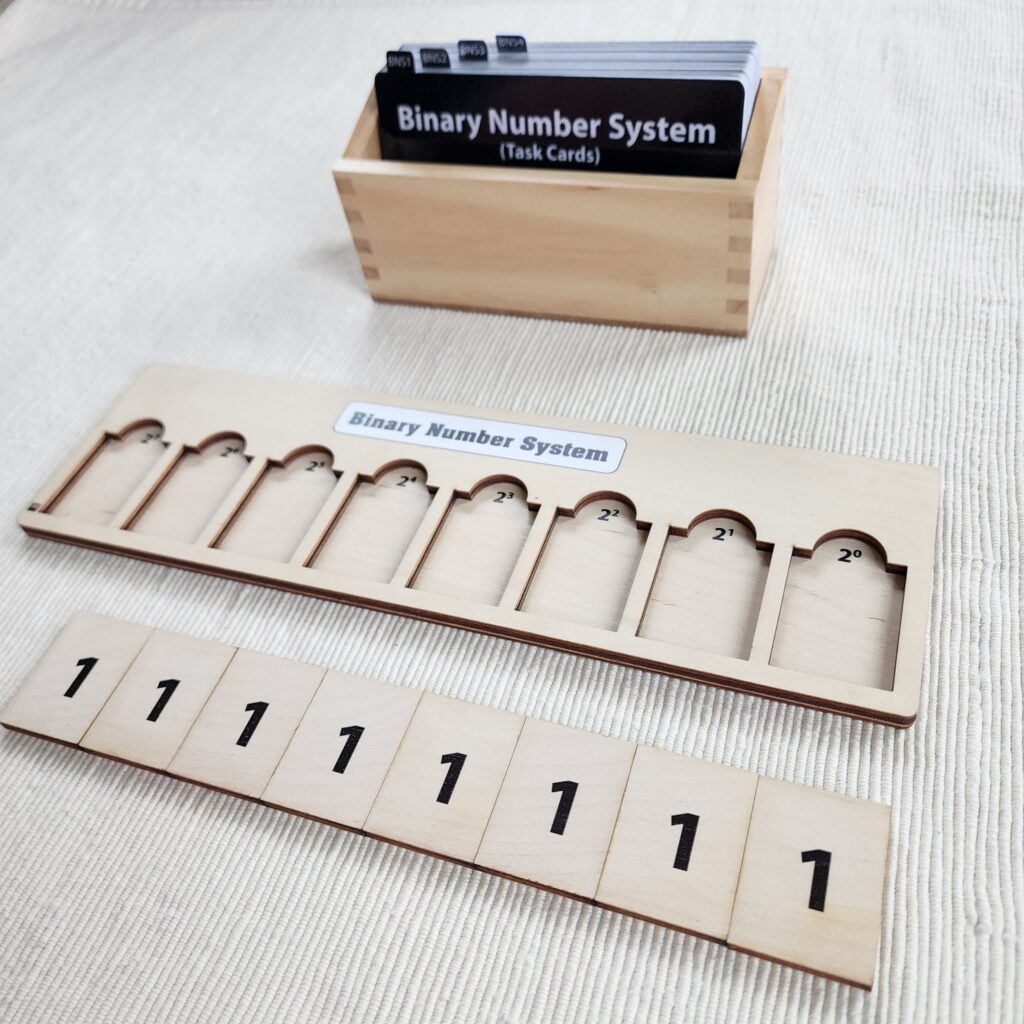
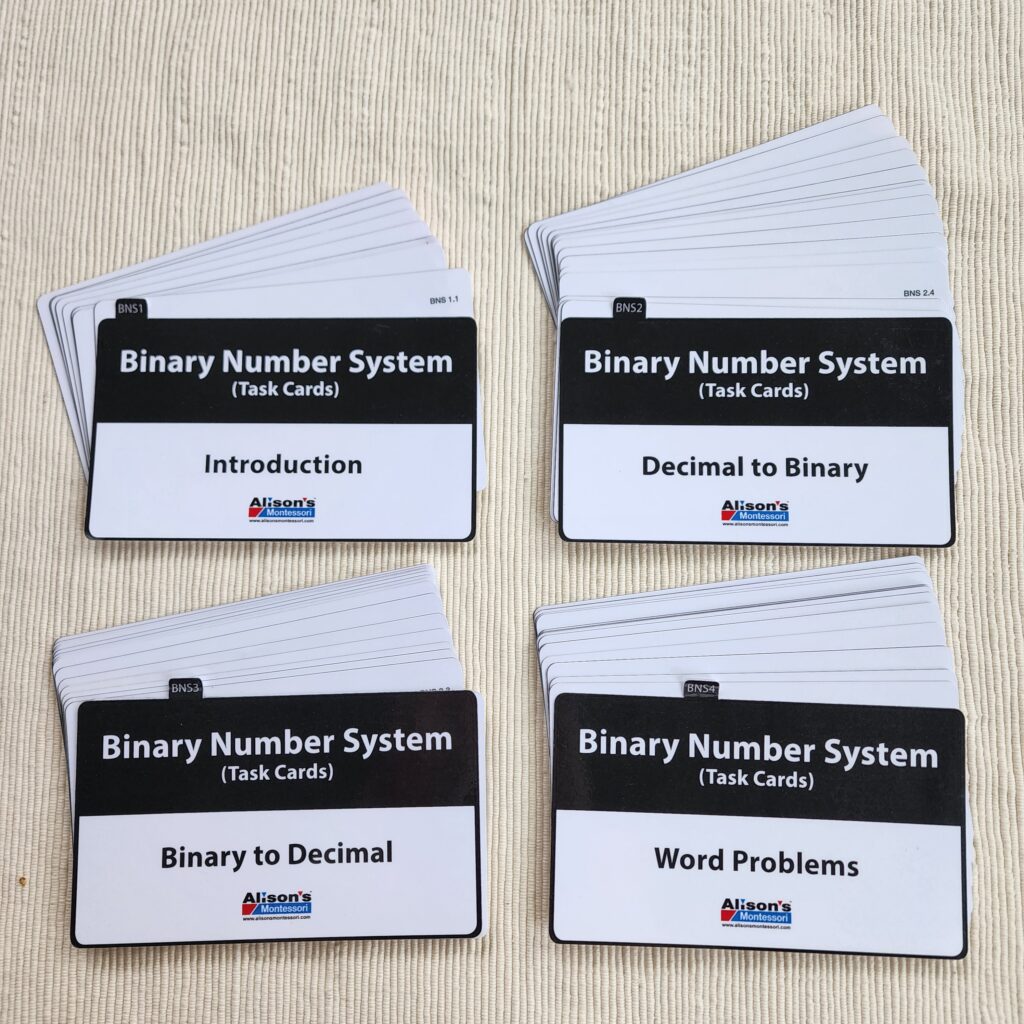
Binary Number System Task Cards
First, you need to understand binary numbers, which are used by computers. Computers are built using millions of “tiny switches” that can be either on or off. These two states are represented by the numbers 1 (on) and 0 (off). This simple system of 1s and 0s is called binary, and is the fundamental language that all computers use to store and process information. The numbers may seem random on our charts, but they follow a clear pattern based on the binary system, which uses only 0s and 1s. Each position represents a power of 2 (2×2, 2x2x2, 2x2x2x2…), and the value increases as you move from right to left. Here’s how to make sense of the pattern.
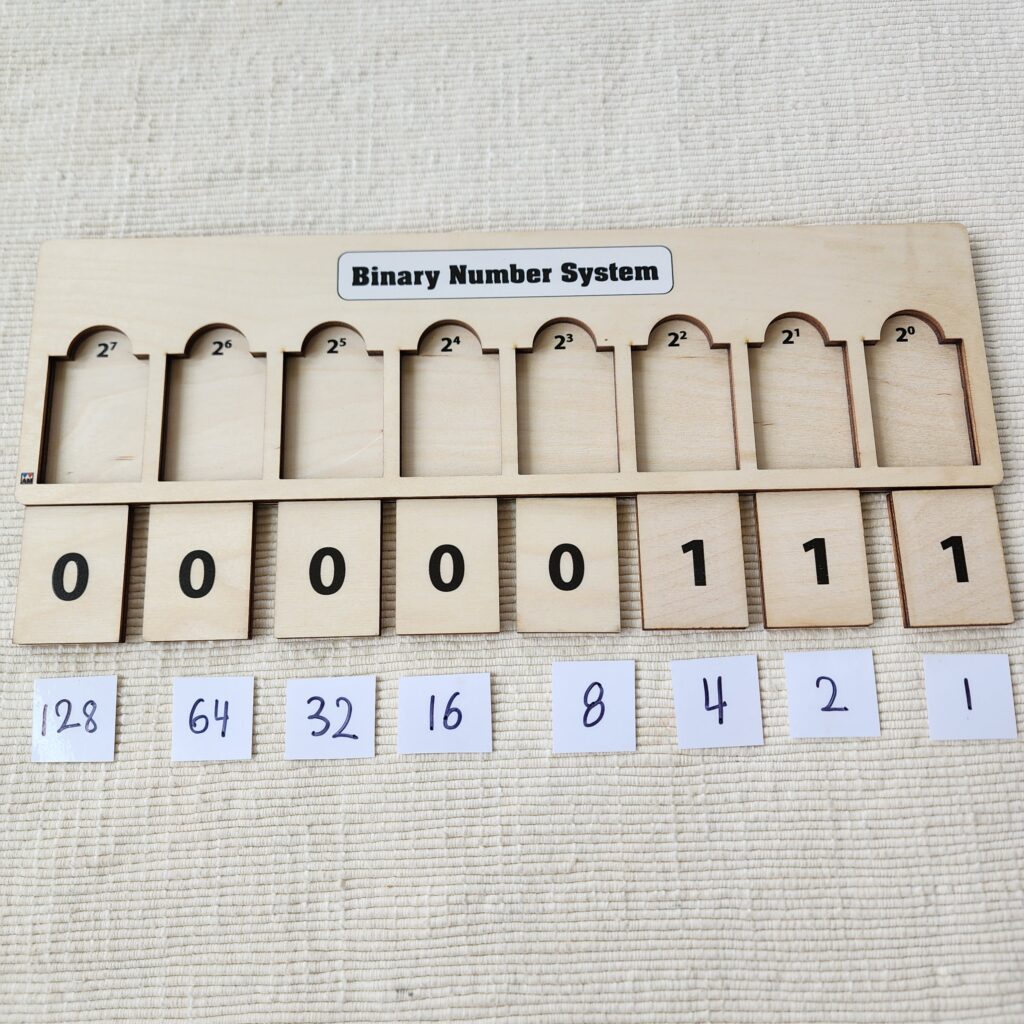
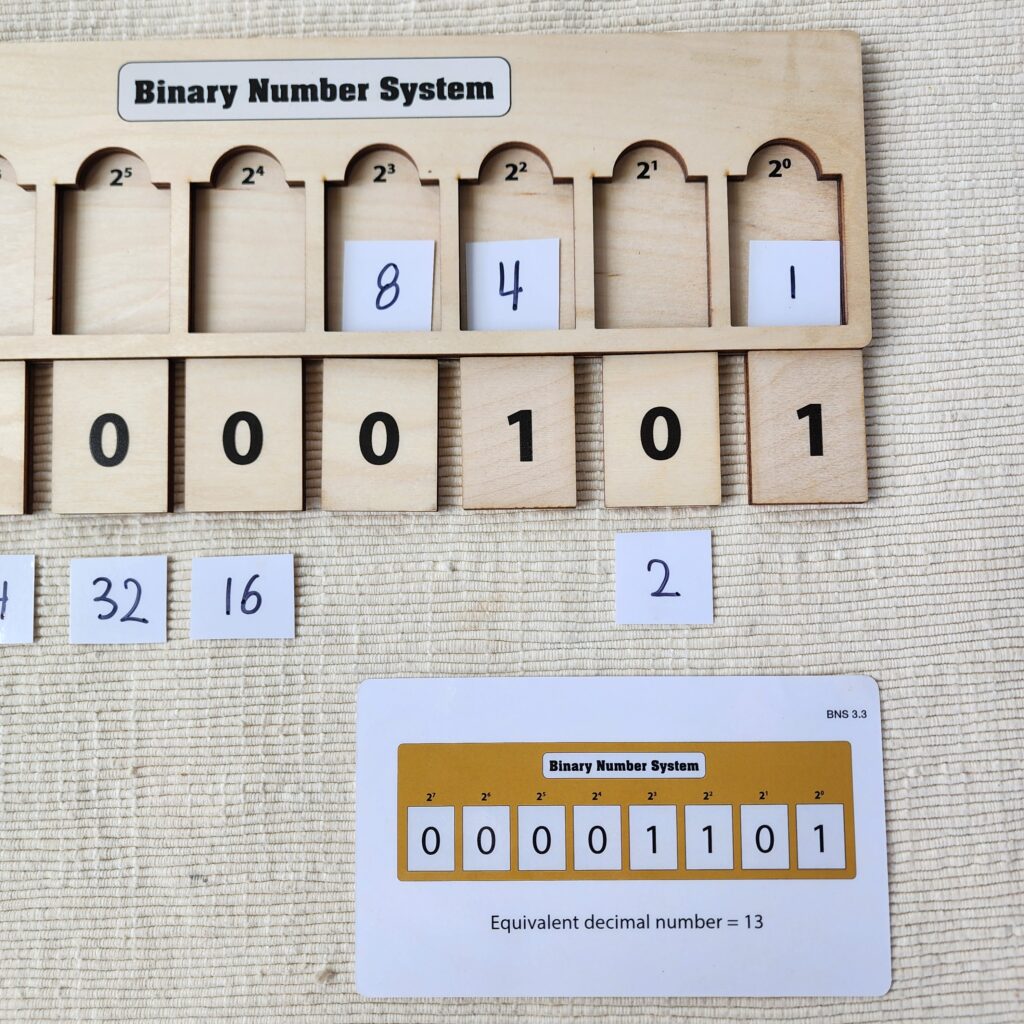
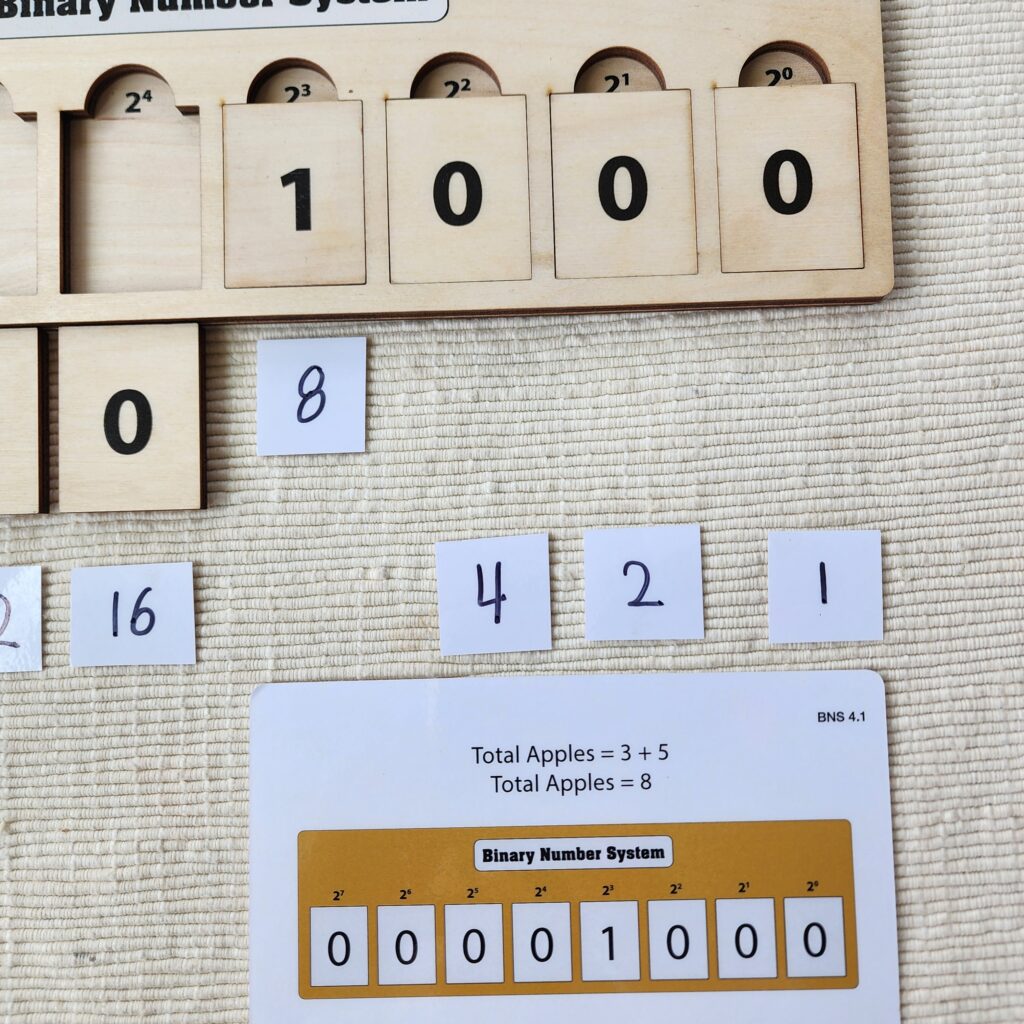
Our wooden board shows a row of boxes, each labeled with a power of 2 (ex., 2⁰, 2¹, 2², up to 2⁷). Starting from the right, each position doubles as you move left. You will find a description for each section of the task cards to help learners progressively grasp the base-2 number system.
Wooden Board with Task Cards
Section 1 – Introduction
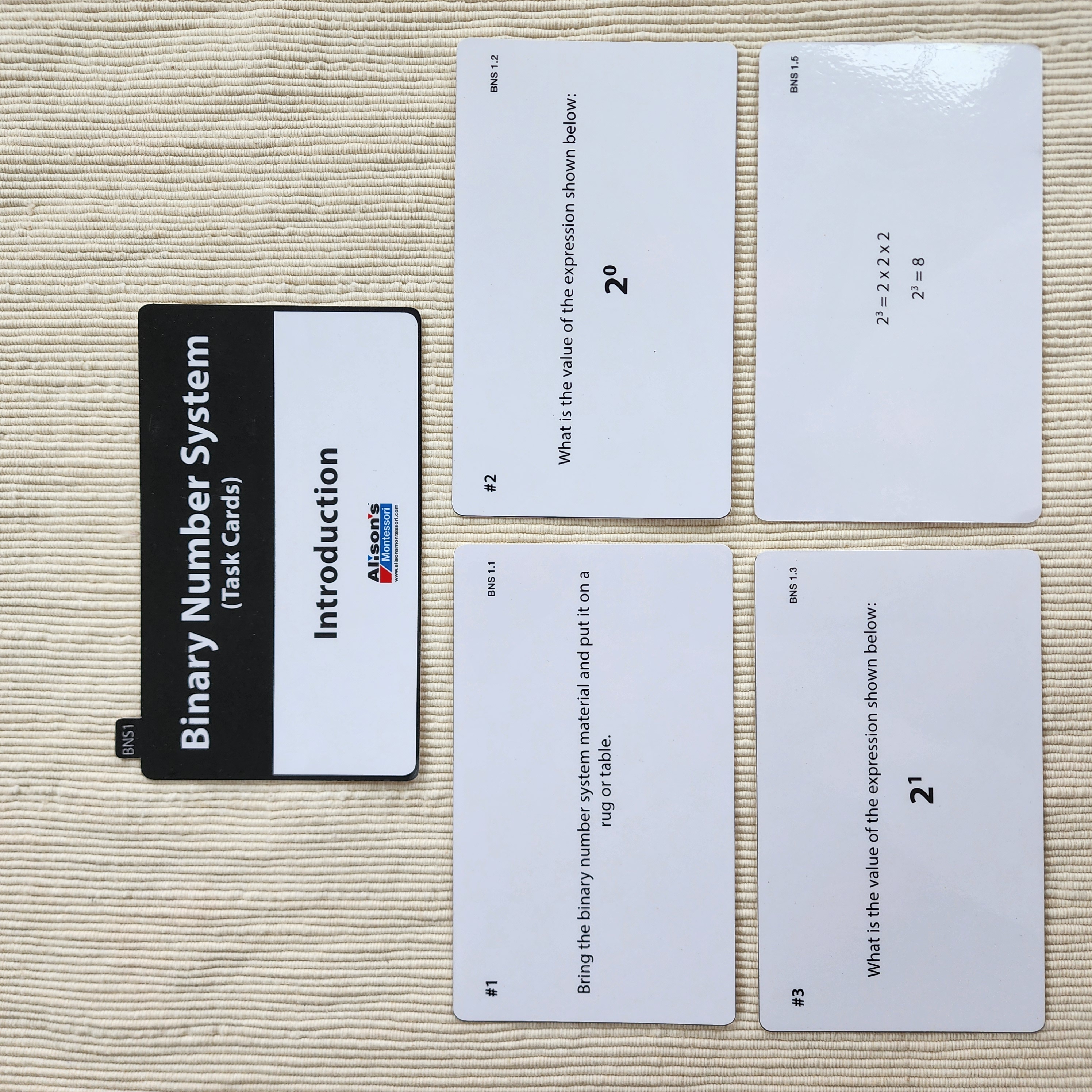
These introductory task cards are designed to help learners understand the value of each place in the binary number system. By calculating expressions like 2⁰ = 1, 2¹ = 2, 2² = 4, 2³ = 8, and so on, learners determine the decimal value of each binary place on the wooden board. This foundational exercise builds number sense and supports mental math skills, helping learners connect the base-2 (binary) system to the base-10 (decimal) system in a concrete, hands-on way.
–
Section 2 – Decimal to Binary
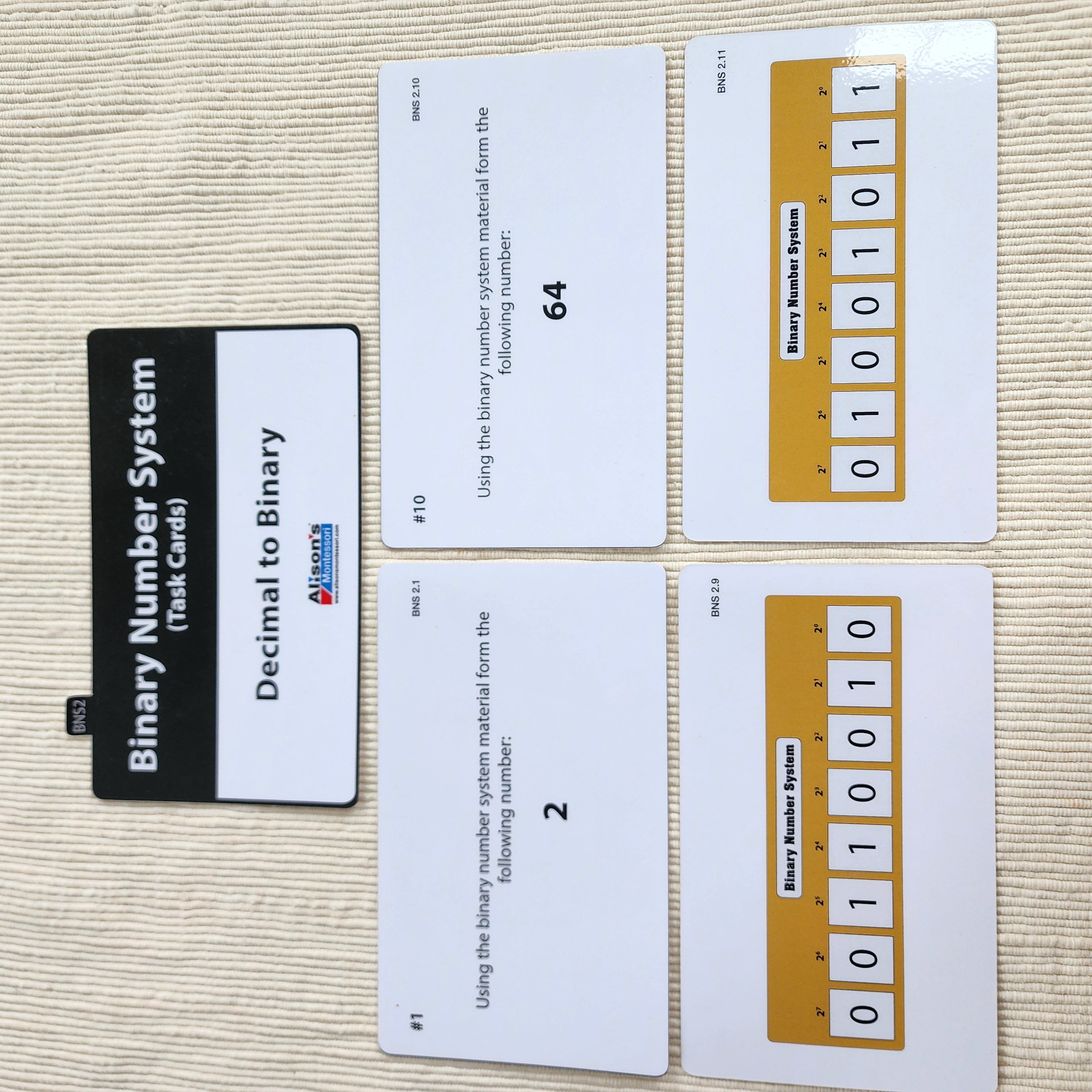
These task cards are used alongside a wooden board to help learners understand how binary numbers convert to base-10 (decimal) numbers. Learners select a task card showing a binary number and place the matching 0s and 1s on the board. Each binary digit (bit) represents a power of 2, with the rightmost digit representing 2⁰. To find the binary equivalent, learners add the values until the sum of the place values forms the given number. Learners should refer to the Binary Number System Chart to find these values if not memorized.
Section 3 – Binary to Decimal
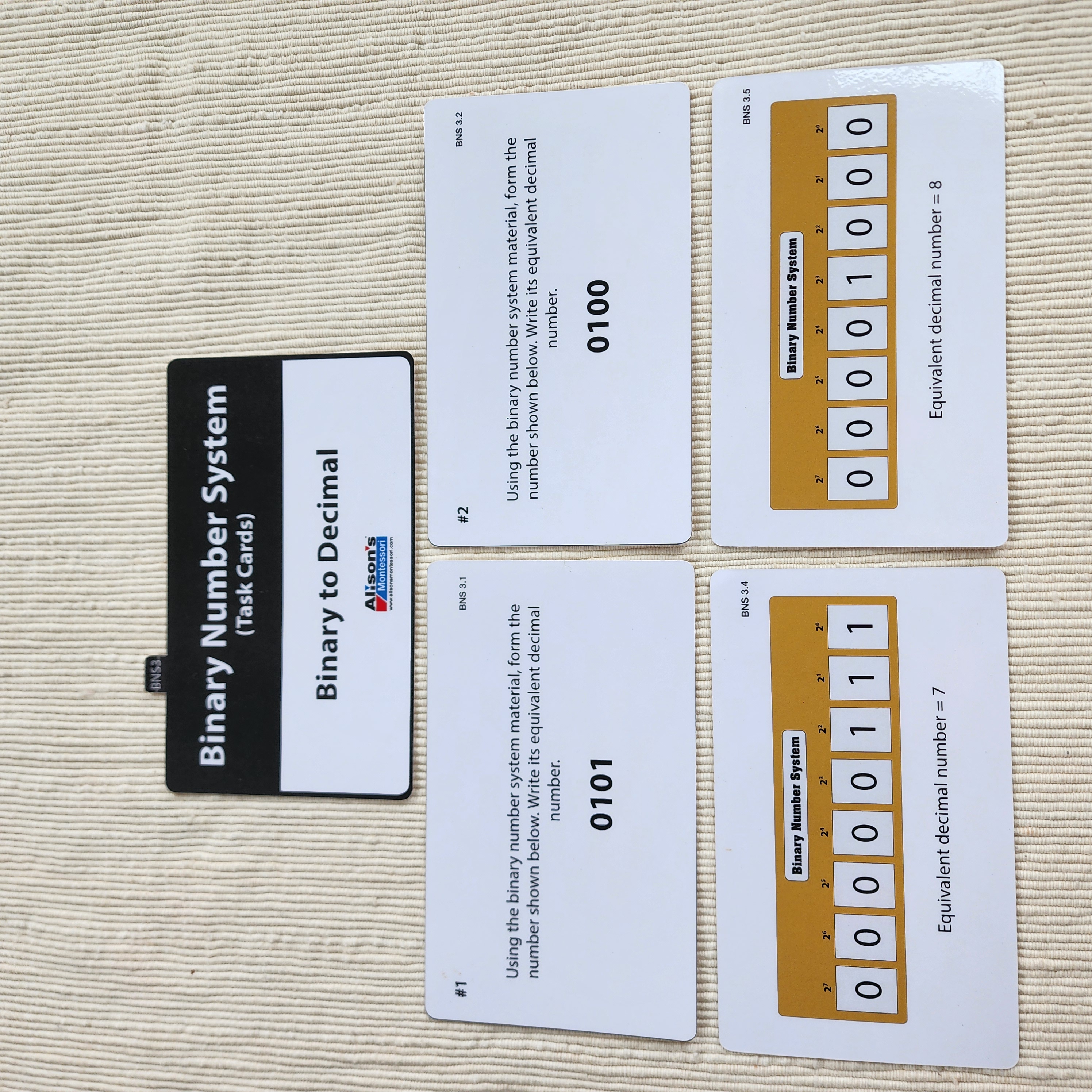
Just as in the previous section, learners use these task cards to convert numbers, but binary numbers (base-2) into decimal numbers (base-10) using the wooden board with movable tiles and the Binary Number System Chart. Each card presents a binary number that learners build on the board, then calculate its decimal value by applying place value concepts.
Section 4 – Word Problems
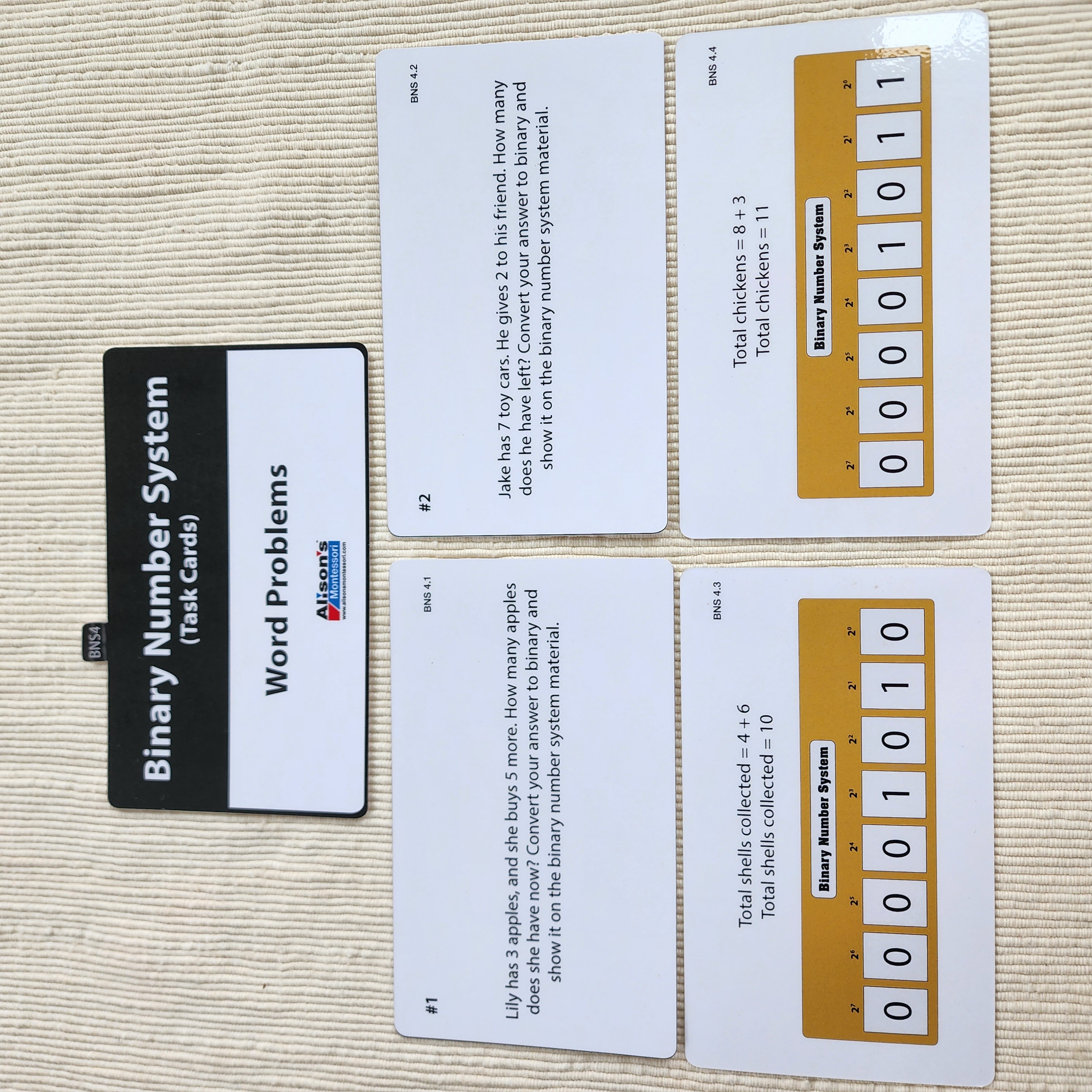
This final section of the task cards focuses on word problems, where learners solve simple math problems and then convert the decimal answers into binary. Each card presents a real-life scenario, and asks students to find the total or difference, then represent that number using the binary number system.
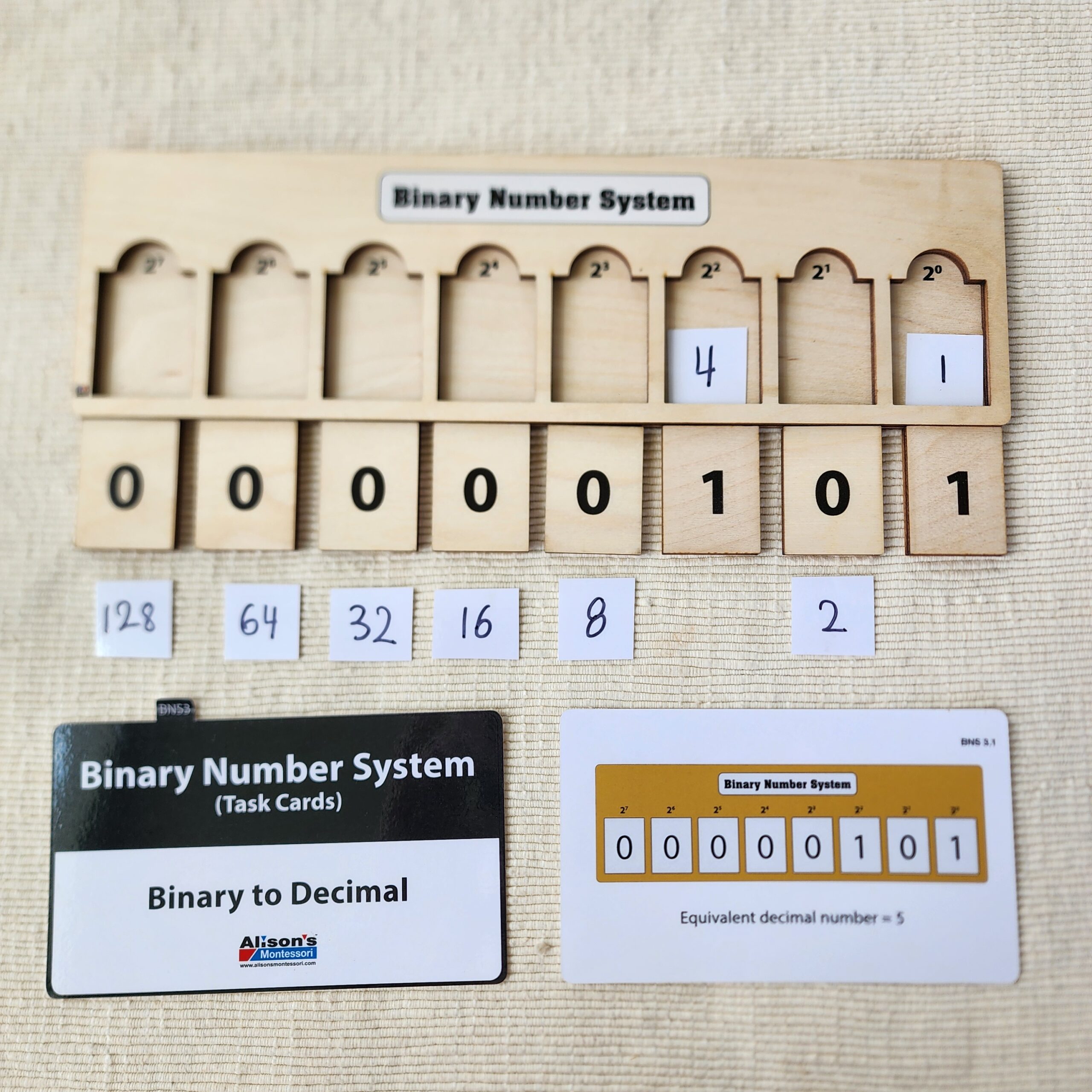
In conclusion, by contrasting the decimal and binary systems using our Binary Number System set, learners not only strengthen their understanding of place value but also gain a concrete sense of how computers represent and process information. Our material makes abstract concepts accessible and meaningful, fostering both mathematical reasoning and early computer science awareness. Through practical application, children build a strong foundation for future learning in our increasingly digital world.